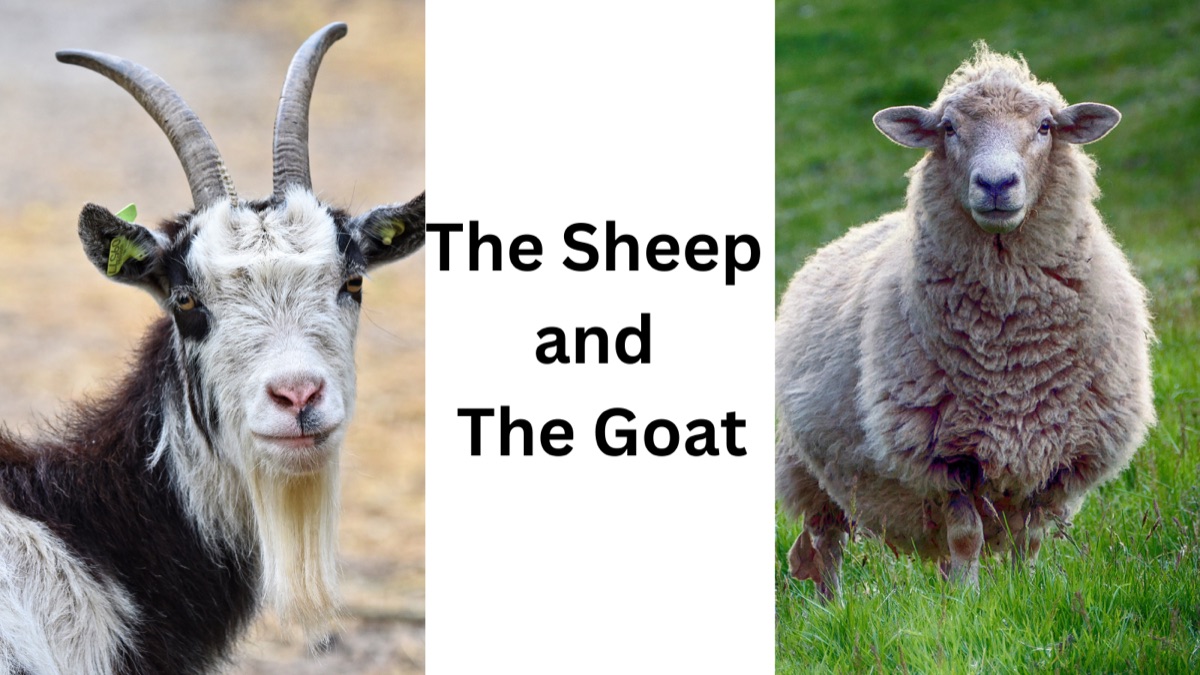
Mathew 25:31-46 narrates the parable of the sheep and the goats. Mathew 25:31-33 “When the Son of man shall come in His glory, and all the holy angels with Him, then shall He sit upon the throne of His glory: And before Him shall be gathered all nations: and He shall separate them one from another, as a shepherd divideth his sheep from the goats: And He shall set the sheep on His right hand, but the goats on the left.” In the Parable of the Sheep and the Goats, we are looking at the redeemed and saved, and those condemned and lost. The “sheep” acted charitably, giving food, drink, and clothing to the needy. The “goats” showed no charity. This seems to result in salvation for the sheep and damnation for the goats. Before we proceed further it would be better to understand the characteristics of both the sheep and goat.
A sheep follows its Shepherd, peacefully moving forward with the flock. He is content to be led because he has faith in His shepherd. A sheep responds to his Shepherd's voice and goes where He directs. On the other hand, a goat follows only its own lead, creating disunity when he comes in contact with others in the flock. Because of his independent nature, he often finds himself in contention with the Shepherd for leadership of the flock, leading some astray.
When Jesus said to Peter “feed my sheep”, he was referring to all who follow him in truth and spirit as he is the good shepherd. Thus, the sheep is synonymous with the children of God. The goat on the other hand points to a fickle-minded lot. They are impulsive, independent and unpredictable, and at times violent fighters. These certainly do not have Christ-like qualities. The question that arises is who is the sheep and who is the goat?
Who the sheep are is clearly indicated by Jesus in the parable in verses Mathew 25:35-36 and verses 39-40. The sheep on Jesus’ right hand are blessed by God the Father and given an inheritance. The reason is stated: “For I was hungry and you gave me something to eat, I was thirsty and you gave me something to drink, I was a stranger and you invited me in, I needed clothes and you clothed me, I was sick and you looked after me, I was in prison and you came to visit me” (Verses 35-36). The righteous will not understand: when did they see Jesus in such a pitiful condition and help Him? In amazement, they will say when did we do this? “The King will reply, ‘I tell you the truth, whatever you did for one of the least of these brothers of mine, you did for me. (Verses 39-40).
As regards the goat, the goats on Jesus’ left hand are cursed with eternal hellfire, “prepared for the devil and his angels” (Verse 41). The reason is given: they had the opportunity to minister to the Lord, but they did nothing (verses 42-43). The damned have the audacity to ask, “Lord, when did we see you hungry or thirsty or a stranger or needing clothes or sick or in prison, and did not help you?” (Verse 44). Jesus replies, “I tell you the truth, whatever you did not do for one of the least of these, you did not do for me.” (Verse 45)
The Lord makes it crystal clear that:
• those who have lived good lives and believed in God will be put to one side and have a place in Heaven
• those who have rejected the belief in God and sinned in their lives will be placed on the other side and will go to Hell
Dr Ashwin Drummond